Podcast: Making the Most of Your Healthcare Visits

How do you make the most of your visits with your healthcare team? In this episode, lung cancer survivor Bill Morris shares his experience with lung cancer and how he approaches his healthcare visits now. Oncology nurse practitioner Rasheda Persinger shares her insights after 20 years of working with patients. Hosts Ann and Dr. Shields discuss with Bill and Rasheda what they wish every patient knew, from writing down questions before an appointment to asking about biomarker testing to why recording your visit can make all the difference. <a href="https://rss

Watch HOPE Summit 2026 Videos

HOPE Summit 2026 was filled with old friends reuniting, new friends being made, and of course, plenty of inspirational and informative sessions designed to help people live well with lung cancer. For the second year in a row, select sessions were recorded so those who could not attend are still able to access the valuable information shared. HOPE Summit 2026 Recorded Sessions Keynote: Wagons Roll with Dr. Ross Camidge Back in the Saddle: Reclaiming Strength and Living Well Charting New Territory with Palliative Care Partners Community Connections Across the Horizon Experts Around the Campfire

Podcast: Why Community Matters in Lung Cancer Care

Why does finding community matter in lung cancer care? In this episode, lung cancer survivor and advocate Jill Feldman shares her experience, from losing multiple family members to lung cancer to her own diagnosis, as well as her work building patient communities around the world. She discusses how connecting with others has shaped her journey and why community is important for support, information, and advocacy. Hosts Ann Steagall, RN, BSN, and Misty Shields, MD, PhD, explore with Jill how patients and families can find community, the role of advocacy, and how care teams can support patients

Podcast: Lung Cancer Diagnosis—What Happens Next

What happens after a lung cancer diagnosis? In this first episode of LUNGevity’s Lung Cancer Voices of Hope podcast, lung cancer survivor Lisa Bistline shares her experience, from initial scans and biopsies through multiple treatments, and the moment a later biopsy revealed a biomarker that led to a targeted therapy. Hosts Ann Steagall and Misty Shields, MD, PhD, then speak with Anne Chiang, MD, PhD, thoracic oncologist at Yale University, about what patients can expect at their first visit, including how doctors determine the type and stage of cancer, plan treatment, and approach care

Veteran Voices: Surgery to Survivorship at the VA

Last November, Michael O’Donnell was at the Dallas VA during Lung Cancer Awareness Month. It’s where he receives treatment for his lung cancer, but on this specific day, he was joined by LUNGevity staff to talk with veterans about screening. “My job was easy. I was at a table with Kristi Griffith [LUNGevity’s Survivorship Navigator] so that I could answer questions as someone who uses the VA to get treated for lung cancer,” says Michael. Michael is a veteran of the Vietnam War and uses the Dallas VA for all his testing and treatment. They don’t have a lung cancer specialist on staff, but

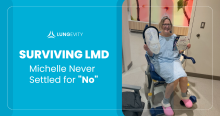
Surviving LMD: Michelle Never Settled for “No”

Michelle knew what was wrong. She knew the headaches, regular vomiting, ear popping, and “whooshing” sounds in her head were all signs of leptomeningeal disease (LMD). The issue, however, is that LMD is so rare—only diagnosed in 5% of people with cancer—she had to advocate for the testing to prove it. “I called my clinic and said I needed a brain MRI because I think I have LMD. They didn’t want to schedule one, so I said, tell my doctor I’m demanding a brain MRI. I can tell him directly if I need to,” says Michelle. Leptomeningeal disease, or LMD, occurs when cancer from somewhere in the body

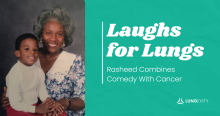
Laughs for Lungs: Rasheed Marshall Combines Comedy With Cancer

Rasheed Marshall understands the secondhand effects of cancer well. First his mom, Joycelyn, was diagnosed with breast cancer in 1995. It came back in 2015 and eventually metastasized (spread) to her lungs. Soon after, his brother-in-law Romain was diagnosed with brain cancer. They both passed away the same week. “It was tough for the entire family when we learned mom’s cancer came back. She didn’t want to go through treatment again—which is why she didn’t tell us about it right away—so when we found out, it was already late-stage and she was put in hospice care until her passing. Romain was

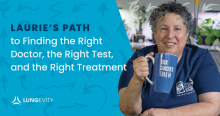
Laurie’s Path to Finding the Right Doctor, the Right Test, and the Right Treatment

Laurie Seligman, a 57-year-old bookkeeper living in Texas, had a lingering cough, but over-the-counter cough syrup seemed to help, so she didn’t think much of it and she continued with her usual activities. One day in 2017, she hurt her back moving a heavy bed, and went to her general care doctor. She mentioned the cough and got an X-ray. After being treated for pneumonia, her symptoms subsided. She had a follow-up X-ray but was told that it was normal for the pneumonia to still be visible on the scans even after the symptoms were gone. “I was told to get a third X-ray in 1-2 months. But when

Linda I. Shares Her Story

I was told on October 11, 2007, that I had non-small cell lung cancer (NSCLC). I was 46 years old with 2 kids — 7 and 12 year olds — at home waiting for me. I had an MRI and PET scan and had my second lung cancer diagnosis. I went to Lombardi Cancer Center in Georgetown (Washington, DC) and they took care of me. Those amazing people guided me on my journey with bilateral lung cancer. I was not aware of biomarkers back then, but I had bilateral thoracotomies and chemotherapy. I survived. In 2016, I was told about my next diagnosis. This time, the treatment was a wedge resection, and I was told